

Every GRP pipe producer, from the most advanced plant to a startup entering the market, faces the same fundamental question, the 1-Dollar Question in GRP pipe production:
“If we invest 1 $ at the top, how much are we getting back at the bottom?”
It sounds simple, but this single question exposes the entire logic of modern composite pipe manufacturing. It shifts the focus from machinery and capacity to what truly matters: effectiveness, efficiency, profitability, and measurable return.
At Topfibra, we see this not as a financial cliché but as the core indicator of industrial maturity. The GRP industry has entered a phase where every dollar spent must create value, not just motion.
Effectiveness Before Efficiency – New Measure of Success
For years, the GRP market judged success by production volume — how many meters of pipe a line could produce in 24 hours. Today, that measure no longer tells the full story.
Energy costs, raw material prices, and labor challenges have made it clear: capacity without efficiency and effectiveness are a cost trap. What producers need is not more movement on the line, but more return on every input dollar.
That’s where the “1-Dollar Question in GRP pipe production” becomes strategic. It’s not about accounting; it’s about engineering discipline. It asks:
- How much of that dollar becomes GRP pipe – and how much disappears into overconsumption, scrap, or downtime?
- How stable and repeatable is the process, regardless of operator or shift?
- How predictable is the ROI of a production investment?
Producers who can answer those questions with data, not assumptions, are the ones building resilient and profitable businesses.
Breaking Down the Production Dollar
Let’s look at what that 1 $ represents inside a GRP plant.
At the Top — Inputs:
- Raw materials: resin, fiber, sand, catalyst, aux materials.
- Energy and utilities: the electricity that drives ovens, pumps, and motors.
- Manpower: operators, supervisors, maintenance staff.
- Machine time: every minute of running or idling counts as cost.
- Setup and changeovers: necessary transitions between GRP pipe sizes or between coupling blanks and pipe production
- Know-how: the quality of technical supervision and process control.
At the Bottom — Outputs:
- Saleable pipe: compliant with standards and accepted by customers.
- Quality consistency: stable mechanical and hydraulic performance.
- Low industrial scrap: fewer rejected pipes, less rework.
- Stable cost per meter: predictable and sustainable over time – effective use of raw material properties
- Process data: insights that feed continuous improvement.
The difference between the two defines your efficiency. Every leak between top and bottom — whether in calibration, curing, or handling — represents money lost.
The EFW® Approach: Closing the Gap Between Input and Output
Topfibra’s Effective Filament Winding (EFW®) Technology was developed with one purpose: to ensure that the dollar invested at the top translates into the highest possible value at the bottom.
Traditional CFW production systems rely heavily on operator experience and manual adjustment. They can produce quality pipes, but the process is vulnerable to variability — one small inconsistency in resin flow or sand distribution can multiply into major cost differences across shifts, and the cost per meter is simply higher.
The E-CFW Line with EFW® Technology addresses this by integrating process intelligence and automation at every stage:
- Controlled material dosing ensures precise resin, sand, and fiber ratios.
- Data-driven winding logic adjusts production values dynamically to maintain balance and curing quality.
- Automated curing systems optimize curing cycles for each diameter and thickness.
- Fast, repeatable changeovers reduce planned downtime and waste.
- Digital monitoring provides real-time visibility into key performance indicators like material consumption, energy use, and line productivity.
The result is a system that transforms the 1-Dollar Question into a measurable efficiency metric. Instead of asking if the line is efficient, producers can calculate how much efficiency and effectiveness they’re achieving – and how that translates into financial return.
Measuring Return in Real Terms
To understand efficiency and effectiveness, producers need to translate engineering performance into business metrics. Here’s how the 1-Dollar framework works in practice:
Return Ratio = (Value of Saleable Output) ÷ (Total Input Cost)
Let’s imagine a traditional CFW line producing a 1 000 mm diameter pipe:
- 10 % of resin is over-consumed due to manual control and
- 3 % of pipe length becomes scrap during curing or calibration.
- 20 % of operational overtime is lost to setup and adjustment.
That means out of every dollar invested, roughly only 0.87 $ becomes value without considering the 20% of operational overtime.
Now compare that to an E-CFW Line:
- Resin overconsumption is reduced to 0% due to the effective use of raw material through EFW® material distribution.
- Scrap minimized to 0.5 %.
- Changeovers completed in a fraction of the time.
This means that instead of 0,87$ you get 0,95$ of real value. The return per dollar climbs significantly. By end of year, if you consider a turnover of $20 million, you will be earning more than 1 million/year.
This is what efficiency and effectiveness looks like when it’s quantified — not slogans, but ratios that appear in the profit-and-loss statement.
Why the 1-Dollar Question Resonated at the Exhibitions We Attended This Year
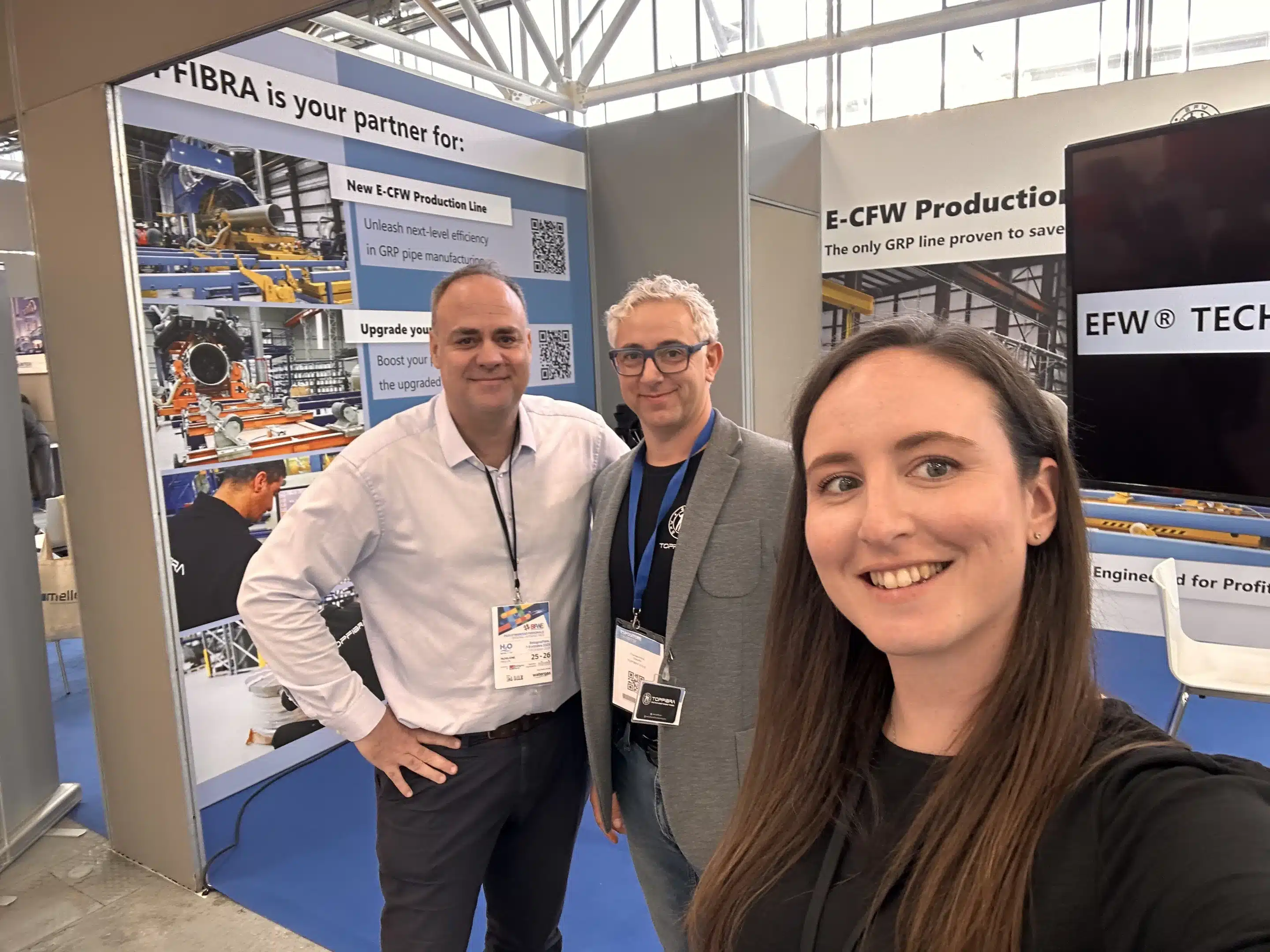
The exhibitions we attended this year — from H₂O ACCADUEO Bologna to EMC Cyprus — clearly confirmed the growing maturity of the GRP industry. Whether in Bologna among water-infrastructure professionals or in Cyprus with energy and industrial players, one theme dominated every discussion: efficiency and effectiveness as main drive of profit and ROI.
At H₂O ACCADUEO Bologna
- The focus was on municipal and water-supply systems, where lifecycle cost drives decisions.
- Visitors were curious about how EFW® technology reduces waste and supports sustainable manufacturing.
- Producers facing competitive tenders for drinking-water networks asked how to maintain profitability when pipe prices are fixed but input costs rise.
- The answer lies in control — every saved kilogram of raw materials adds directly to margin.
At EMC Cyprus
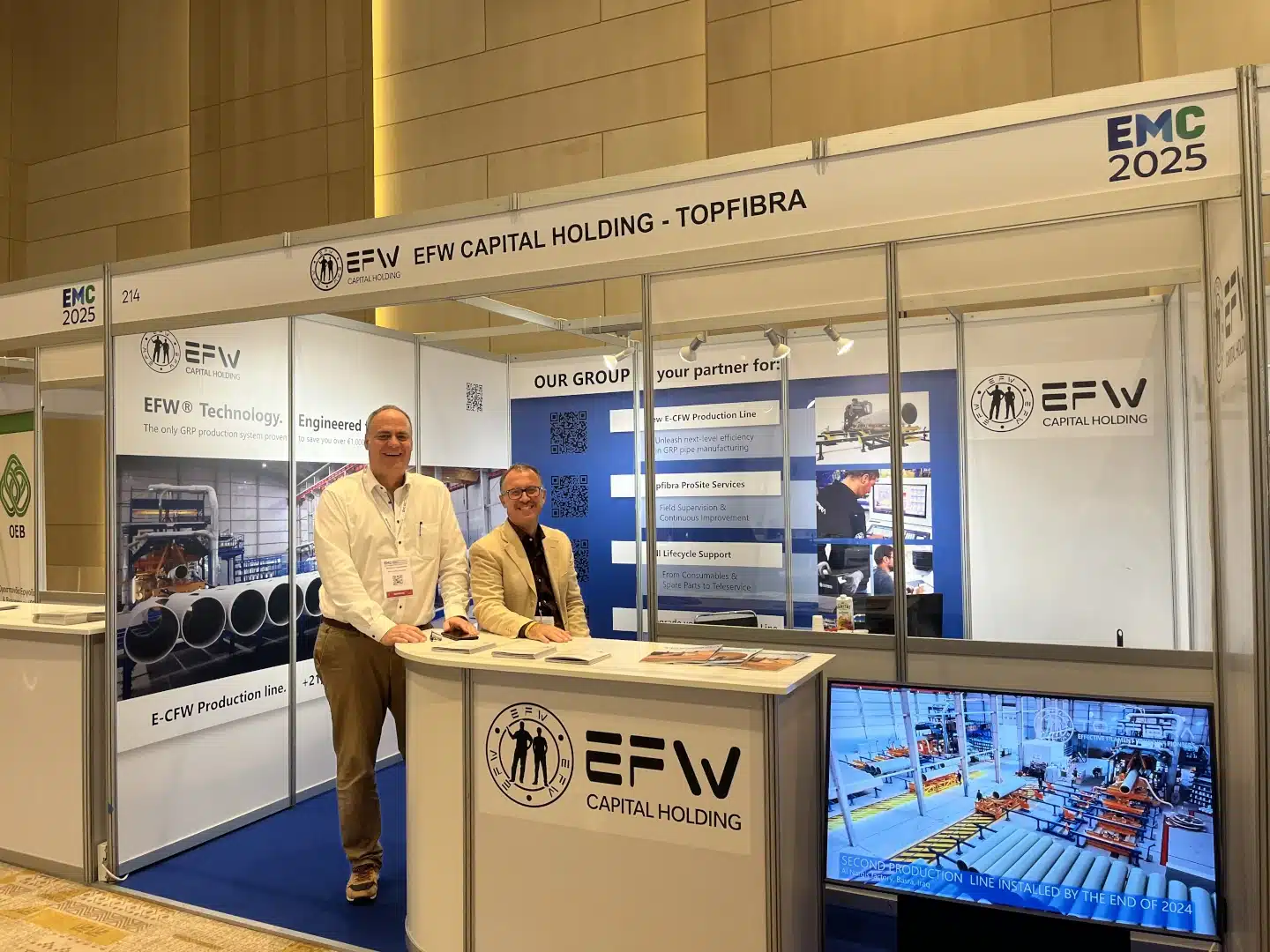
- The conversations centered on industrial and energy infrastructure — cooling systems, desalination, and power-plant pipelines.
- Here, the pressure is on performance and delivery time.
- Attendees wanted to understand how E-CFW Lines maintain process stability under continuous operation and how automation shortens learning curves for new teams.
- They recognized that EFW® technology isn’t only about equipment — it’s a complete system of process, technology, and people working together to make each invested dollar perform better.
These events confirmed what we already see in daily client interactions: the industry is redefining efficiency not as “doing more” but as “getting more back” — the 1-Dollar Question made visible.
Three Dimensions of Efficiency and Effectiveness
1. Strategic Efficiency and Effectiveness — Aligning Technology with ROI
Producers no longer want generic solutions. They want systems designed to generate predictable returns.
E-CFW Lines are built on a modular approach where each element — winding unit, curing system, control architecture — serves a clear financial purpose: maximize throughput, minimize waste, and stabilize output.
The ability to track input vs. output in real time makes ROI a living metric, not an annual guess. Strategic efficiency and effectiveness mean every technical decision has a financial consequence.
2. Proven Efficiency and Effectiveness — Data Instead of Assumptions
In a typical CFW line, operators rely on experience to judge if the process is “right.” In EFW® systems, sensors and control loops provide measurable data on material flow, speed, and curing.
This replaces subjective evaluation with objective proof. When data confirms consistency, efficiency becomes demonstrable.
It also supports continuous improvement: comparing line performance week by week to identify where that 1 $ is leaking and where it’s multiplying.
- Profitable Efficiency and Effectiveness — Making Every Dollar Work Harder
True efficiency and effectiveness turn time, energy, and material into profit.
By reducing variability and overconsumption, Topfibra clients achieve a lower cost per meter and higher output per shift, without increasing operator load.
Profitability doesn’t come from cutting corners; it comes from precision. Each parameter refined, each kilogram optimized, each minute recovered — all of it translates into measurable gain at the bottom.
A Shift in Industry Mindset
The most powerful outcome of both exhibitions wasn’t the number of visitors or inquiries — it was the tone of the conversations.
A decade ago, the main question was “What’s the maximum diameter you can produce?” or “How fast does the line run?”
Today, it’s “How can I make my production more profitable?”
That shift signals a cultural change in the GRP sector. Efficiency has become the common language between technical managers and financial directors. Everyone, from the production floor to the boardroom, is asking the same question: what’s our return at the bottom?
Topfibra’s role is to guide that transformation. By combining engineering, automation, and know-how transfer, we help producers not just install equipment but build efficiency and effectiveness into their production DNA.
Beyond Machines: The People Behind the Process
Technology alone doesn’t guarantee a good return. The human factor — training, process understanding, and operational discipline — plays a decisive role in turning investment into output.
That’s why EFW® is a system transferred with know-how, not only a set of machines. Our engineers stay on site during commissioning and startup and later our production specialists stay as much as needed to help teams shorten their learning curve.
We measure success not by machine delivery but by when the client reaches full profitability.
This partnership approach means that by the time a plant is fully operational, the local team can independently sustain the same level of process control and profitability. That’s how the 1 $ invested keeps generating returns long after installation.
From Cost to Culture
When efficiency and effectiveness become culture, every decision – technical or managerial – starts from the same principle: does this increase our return per dollar?
This mindset drives continuous improvement:
- Preventive maintenance instead of reactive fixes.
- Standardized recipes for repeatable quality.
- Data reviews at the end of each shift.
- Clear communication between production and management.
Over time, this culture compounds its value. Plants that operate under such discipline not only produce cheaper and better but also adapt faster to market changes. They can switch diameters, meet urgent orders, or expand capacity without chaos.
That’s the true meaning of creating culture in efficiency — not slogans, but a measurable transformation of how people think about production.
Learning from the Field
The feedback we received during the exhibitions confirms that producers everywhere face similar challenges:
- Material volatility: fluctuations in resin and fiber prices make precise consumption control essential.
- Energy costs: rising electricity prices penalize inefficient curing and idle time.
- Workforce turnover: new operators need systems that guide them, not rely on guesswork.
- Market pressure: clients expect lower prices and faster delivery without compromising standards.
EFW® Technology addresses each of these points through a balanced combination of hardware, software, and human expertise.
For example:
- Automated material calibration adjusts in seconds, not hours.
- Integrated data logs allow management to review production efficiency remotely.
- Recipes ensure that every pipe meets the same mechanical targets, regardless of operator.
- Predictive maintenance to avoid unplanned downtime.
These are the small, consistent actions that turn 1 $ into sustainable value.
Looking Ahead
As GRP applications expand into renewable energy, desalination, and high-pressure systems, efficiency and effectiveness will become even more critical. Investors and end-users will evaluate suppliers not just on product quality but on production intelligence — the ability to deliver more with less.
The 1-Dollar Question will therefore evolve from a thought experiment into a standard business metric.
Companies able to show their efficiency ratio — how much value comes out for every dollar invested — will attract more partnerships, funding, and market confidence.
Topfibra’s mission is to provide the technology and the method to make that measurement real and positive.
Conclusion: Turning the Question into a Benchmark
The GRP pipe industry stands at a turning point. Those who understand the financial meaning of efficiency and effectiveness will lead the next generation of production.
When we ask “If we invest 1 $ at the top, how much are we getting back at the bottom?” we’re really asking:
- How well do we control our process?
- How smartly do we use our resources?
- How effectively do we convert cost into value?
With EFW® Technology, the answer is no longer abstract. It’s visible in production data, confirmed in output quality, and measurable in return. Topfibra delivers efficiency and effectiveness as a system. Equipment, EFW® technology, and people working together to turn cost into value.
The future of GRP manufacturing belongs to those who can turn every invested dollar into a symbol of efficiency, intelligence, and profit.
Want to Learn More?
Contact our team for a personalized assessment and discover where your production dollar can go further.
Because in the end, the real question is not how much we spend, but how much we get back.